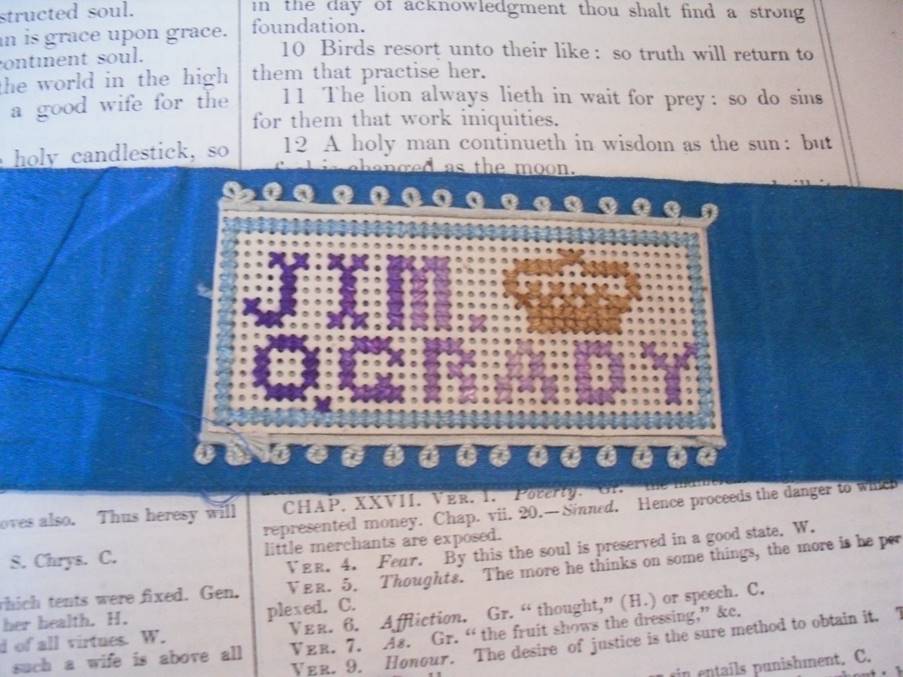
Image of an embroidery which says Jim O’Grady with a crown. In Irish culture the crown did not relate to the royal family, but to the idea of someone being celebrated. It sits within our family bible, and we did not know who it was for until recently.
Porirua Cemeteries and City Council have announced this week that they are seeking families who have members lying in unmarked graves in their cemeteries. They’ve released a list of names:
My Great Great Uncle James O’Grady was at Auckland Asylum and later Porirua until he died in the late 1940s. When we heard about him in the 2010s, we knew very little about him, and had puzzled over the embroidery (above) which is in the big old Irish Catholic family bible which (it turns out) James’ big sister Bridget Agnes O’Grady was given by her mother Brigid upon her marriage to our Great Great Uncle William O’Grady in 1891.
I’ve written the story of piecing together James’ life: The disappearance of James O’Grady : mental health in Aotearoa in the early twentieth century / by Emma-Jean Kelly
If you want to research a family member when all you have is a name and the knowledge they were in the asylum system, then here’s how to start.
As a result of the years’ long Royal Commission on Abuse in Care Inquiry which has recently ended, the Citizens Advice Bureau has been funded to set up a first port of call for survivors themselves to access their records: https://www.konae.org.nz/
Family members of those who have passed also have the right to request records to try and understand their life. You can start with the same website above. If you are a survivor yourself, please consider accessing the support of Survivor Experience Services, who I’m happy to say are being funded to continue their good work: https://survivorexperiences.govt.nz/
We were lucky enough that James’ body was sent home when he passed – he lies in a grave with his mother Brigid O’Grady, his sister Bridget Agnes Kelly and my Great Great Uncle William.

Image of our family grave with James O’Grady’s inscription underneath his sister and his mother’s. The text says ‘On whose soul sweet Jesus have mercy, R.I.P. James O’Grady, Died 11th June 1949 Age 75 years’. I don’t like this text – James had nothing to seek mercy for, but the authorities who incarcerated him for his whole adult life certainly do.
I can tell you a little about what happened in the government asylum system based on my research and my reading of the reports of the Royal Commission. Patients were often neglected or maltreated, and they were put to work for little or no pay. My colleague Jared Davidson calls this practice in relation to prisoners ‘unfree labour’. The women usually worked inside the asylum in the laundry, and there are descriptions of the women working in ankle deep water since the laundry often flooded.
James and other men helped build structures on the site, and worked for free in a farm system which ensured good fresh food for the hospitals across the country grown at little expense to the Crown. James worked in the award-winning piggery. And let’s not forget where the land came from for the asylums – mana whenua iwi Māori, with or without their consent.
When you start asking for your family members’ files, expect a bit of resistance. Many government departments haven’t quite got their head around the fact that we all need information which they regard as theirs, and private. If it’s your family member, or your own file, keep pushing.
I’ve gone back to my long process of getting information on my Great Great Uncle James O’Grady. My request was treated as an OIA (Official Information Act request, not by me – that’s what they called it) I was asked to provide the following information by the Police Liaison and Coroner’s Office:
- A copy of your photo ID
- A copy of your family tree; and/or
- Family birth certificates showing your link to James O’Grady
All I could provide was photo ID and a written family tree, but they accepted that. I was then sent this letter, feel free to use it yourself as needed:
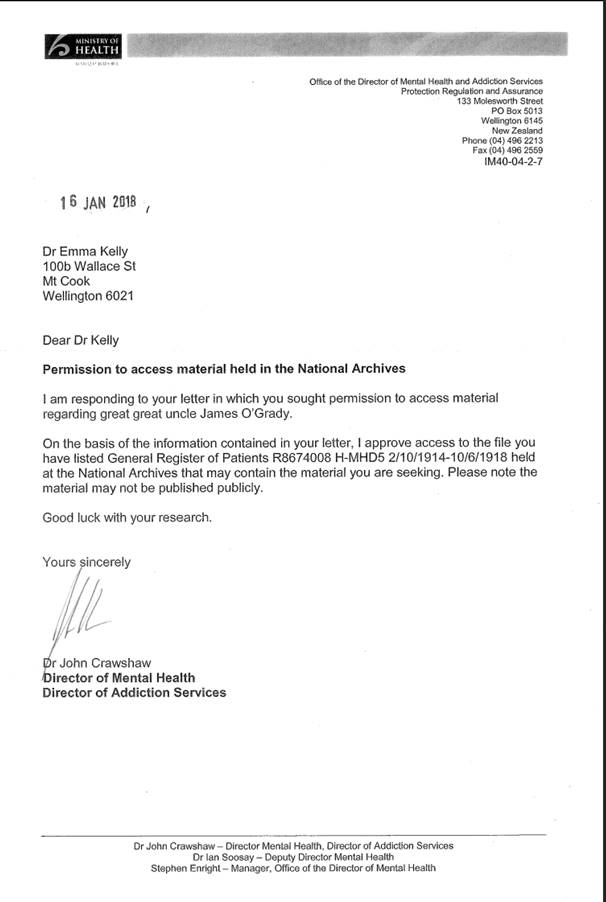
Letter from Dr John Crawshaw, Director of Mental Health, Director of Addiction Services, to Emma Kelly, granting permission for me to access my Great Great Uncle’s file listed General Register of Patients R8674008 H-MHD5 2/10/1914-10/6/1918 held at the National Archives.
I suggest you show or quote this letter because it shows evidence for a family member of someone deceased many years ago being able to access their files. I have actually undertaken this process twice – the second time for a much more recently dead family member. I received a huge box of files for them, but in the case of James, just a large folder. Oh, and I did publish from the file, and explained why when I had the chance to Archives NZ staff – the State made my Great Great Uncle disappear for one hundred years. There was no way I was going to perpetuate that terrible situation any longer. It’s hard to describe how sad and angry I still feel about this, but I can assure you, writing about him, sharing with my family and others, has helped. If I feel that distressed, I cannot imagine how frustrated survivors of abuse in care must feel. We must listen to them and their stories.
If you are still struggling, quote this:
The Health Information Privacy Code, Principle 11, Office of the Privacy Commissioner | Principle 11 – Disclosure of personal information cites the Information privacy principle 11: Limits on disclosure of personal information. It says:
- An agency that holds personal information must not disclose the information to any other agency or to any person unless the agency believes, on reasonable grounds, –
- That the disclosure of the information is one of the purposes in connection with which the information was obtained or is directly related to the purposes in connection with which the information was obtained”
And…
Rule 11 of the Health Information Privacy Code, which describes limits on disclosure of health information, says:
(6) This rule applies to health information about living or deceased persons obtained before or after the commencement of this code. [But]
(7) Despite subrule (6), a health agency is exempted from compliance with this rule in respect of health information about an identifiable deceased person who has been dead for not less than 20 years.”
If, like James, your family member was in more than one asylum, it may take a while to work out who holds his files. In our case, the Capital Coast District Health Board had the whole file, including James’ time in Auckland, so the first letters I got back seemed to be confused as to why I would ask for this information, didn’t know anything, and were dismissive and unhelpful.
Don’t give up – James’ file is sadly the most detailed information we have about him. It has led me to feel very passionately about remembering those who were caught up in an awful and inhumane system, and finding ways to support and memorialise them, whatever the government itself decides to do – or not do.
Our family are lucky, and have a magnificent grave which includes memorials for a number of family members, including James. We can go there and remember him. Others aren’t so lucky, and I hope in the future they will be able to help advise on an appropriate memorial for their family members.
If your family member passed at Porirua, they may be in an unmarked grave. Check the list here:
and follow-up the contact details. Porirua Library has a genealogist who can help you try to find out more. If your family member was elsewhere, start asking your local council what they are going to do in response to the recommendations of the Royal Commission Inquiry into Abuse in Care to memorialise those caught up in a dreadful system.
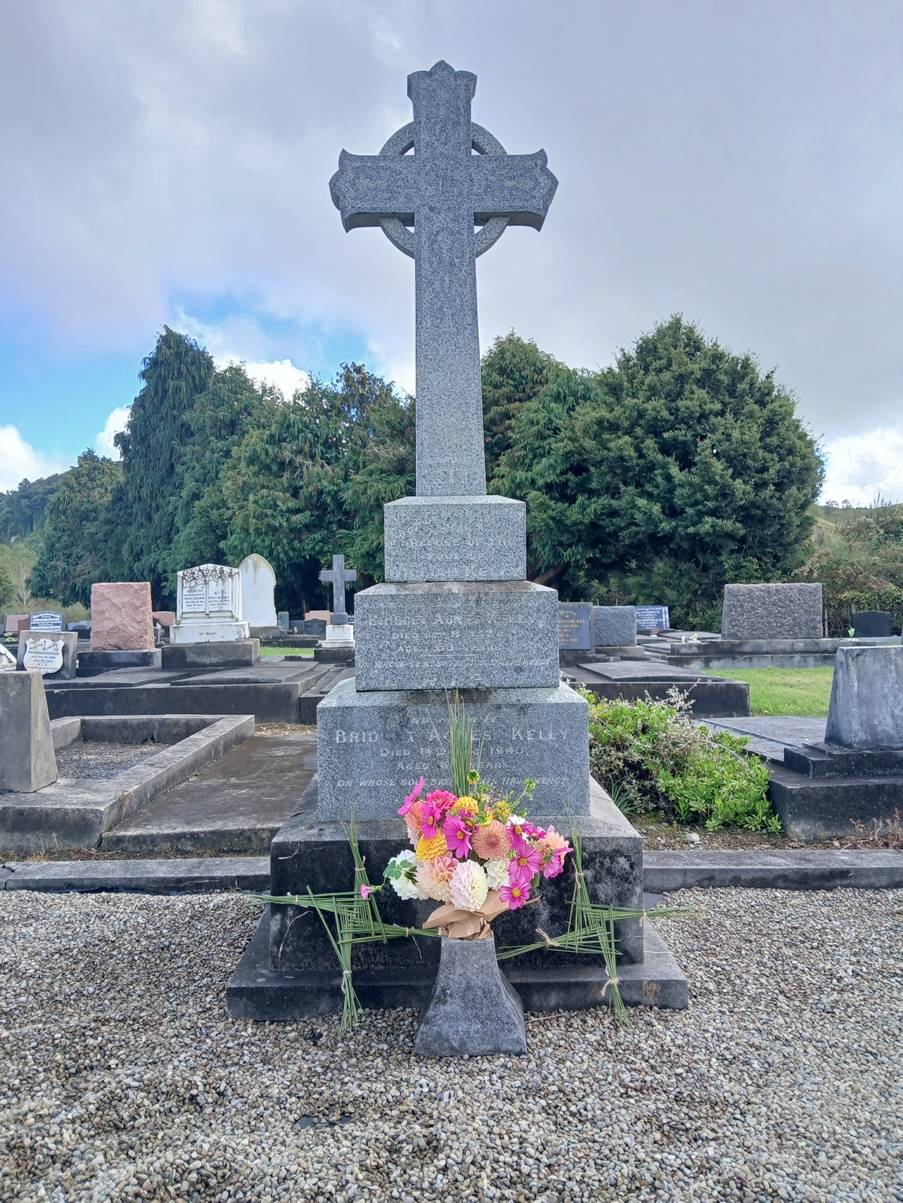
Kelly and O’Grady family grave with Brigid’s crosses and fresh flowers.
Follow-up 14th May 2025
Yesterday I went out to Porirua to meet with Daniel Chrisp who is leading the project to get a memorial/s created to remember those in unmarked graves. He told me some of the history of the site, and it was shocking to learn that the asylum grounds were at their peak 1000 acres! All the way up to what was then called ‘Colonial Knob’ from the road near the cemetery was the grounds which housed so many people, but also grew food and produced so much. The care and attention that is taken by the gardeners, cemetery workers and headstone makers is really quite something to behold and worth our appreciation. To realise how much of the ground beneath my feet as we walked through that cemetery contains unmarked graves of people who were patients of the asylum is truly shocking. I hope more descendants will be able to tell the stories of their family members in the future and acknowledge and engage with them.
 Kelly O'Grady Dron Clan Histories